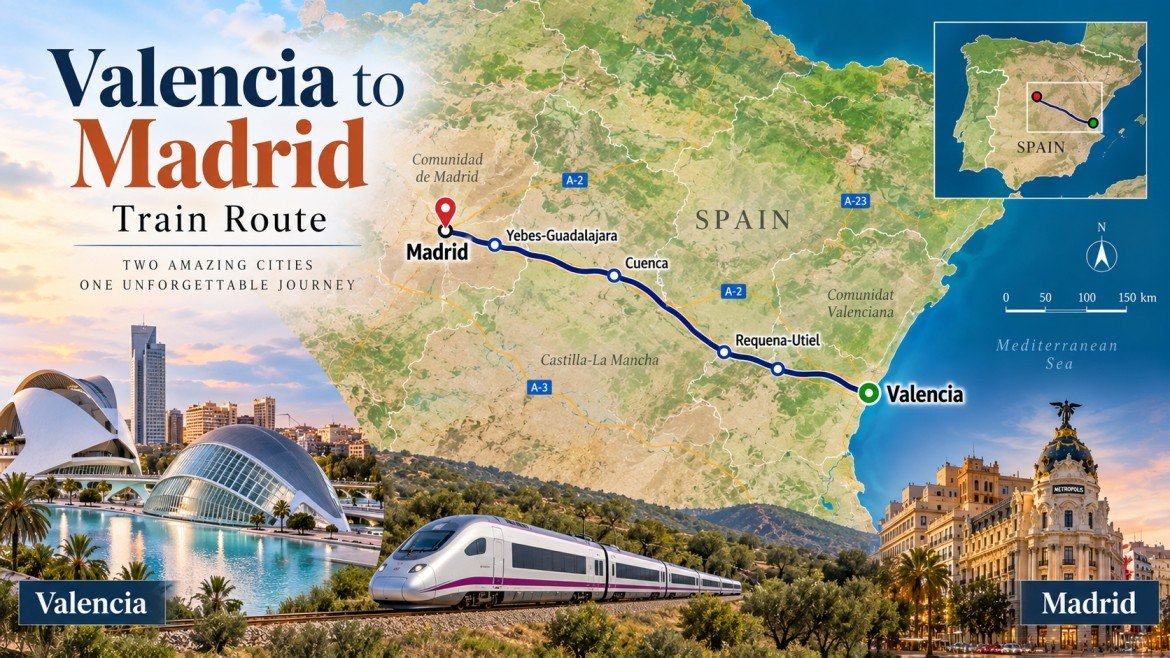
Valencia to Madrid is one of Spain’s quickest major AVE routes — under two hours on the fastest trains, which makes it a popular day-trip and business connection as much as a tourist route. Here’s what you need to know: duration, cost, which operator to pick, and practical booking tips.
Is There a Direct Train from Valencia to Madrid?
Yes. Direct high-speed trains run throughout the day between Valencia Joaquín Sorolla and Madrid, operated by AVE, Avlo, iryo, and OUIGO. Around 18 to 25 trains run daily, making this one of the most frequent long-distance routes in Spain.
Valencia to Madrid Train Duration
The fastest direct trains cover the 391 km route in as little as 1 hour 54 minutes to 1 hour 56 minutes. Some AVE services make an intermediate stop at Cuenca Fernando Zobel or Requena-Utiel, which adds roughly 10 to 15 minutes, bringing the total closer to 2 hours 5 minutes to 2 hours 10 minutes.
Which Operator Should You Book: AVE, Avlo, iryo, or OUIGO?
Like most of Spain’s busiest AVE corridors, this route has real competition between operators, so it’s worth comparing before you book.
AVE, Renfe’s flagship high-speed service, offers the most departures throughout the day and the widest range of fares, from budget-friendly Básico tickets to fully flexible, higher-comfort options.
Avlo is Renfe’s no-frills budget version of the AVE, using the same fast trains but with a stripped-down fare — a solid choice if you don’t need flexibility or extras.
iryo is a private operator offering full-service comfort similar to AVE, often with competitive pricing and its own onboard perks.
OUIGO is the lowest-cost option in most searches, though seating is more basic and add-ons like luggage space or date changes typically cost extra.
For this particular route, price differences between operators can be significant since departures are so frequent — it’s genuinely worth comparing a couple of options for your specific time slot rather than just booking the first result.
Valencia to Madrid Train Cost
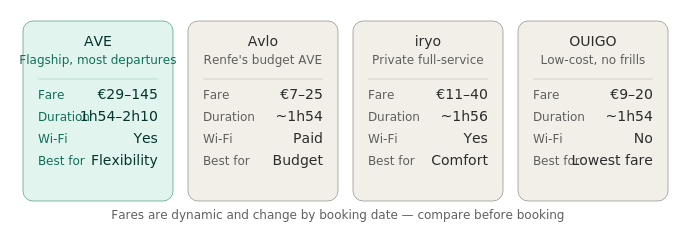
- Budget fares (Avlo, OUIGO): often available from around €7–€20 for early or off-peak bookings
- Standard AVE fares: typically €29–€65 depending on timing and demand
- Flexible or premium AVE fares: can run up to roughly €145
As with other Spanish AVE routes, pricing is dynamic — the cheapest slots are usually mid-afternoon on weekdays, while early morning and evening departures (popular with business travelers) tend to cost more. Booking around three weeks ahead typically saves a meaningful amount over last-minute fares.
How to Buy Tickets
Book AVE and Avlo tickets through renfe.com, and iryo or OUIGO through their own sites, since not every fare shows up on third-party resellers. Comparison sites like Omio are useful for checking all four operators side by side before you commit to one.
Valencia to Madrid Train Schedule
Trains run from around 6:30 AM until roughly 9–10 PM, spaced closely together throughout the day — often every 30 to 60 minutes during peak periods. Because this is such a high-frequency route, it’s usually easy to find a convenient departure even if you’re booking just a few days out, though the cheapest fares still go first.
Station Guide
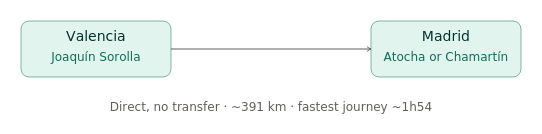
In Valencia, trains depart from Joaquín Sorolla, the city’s high-speed rail terminal, centrally located near the historic center.
In Madrid, trains use either Puerta de Atocha or Chamartín depending on the operator and specific departure — OUIGO and iryo commonly use Chamartín, while Renfe AVE services split between both. Always check which station your ticket lists, especially if you have onward connections planned.
Practical Tips
- Seat reservations are included automatically with every ticket, regardless of operator.
- Check whether your train makes an intermediate stop (Cuenca or Requena-Utiel) if travel time matters to you — direct services are noticeably faster.
- Confirm which Madrid station your ticket uses (Atocha or Chamartín) before planning your onward transport.
- Book early for the cheapest fares, especially for early morning or evening departures, which are popular with business travelers.
- Arrive at least 20–30 minutes ahead, particularly during peak commuter-style travel times.
Other Ways to Travel from Valencia to Madrid
By Bus
ALSA and other operators run the route in around 4 hours — considerably slower than the train, but often the cheapest option if booked well in advance.
By Car
Driving via the A-3 motorway takes about 3.5 to 4 hours, offering flexibility for stops, though you’ll need to budget for tolls and parking in both cities.
By Air
Flights take under an hour, but by the time you add airport transfers, check-in, and security, total travel time is often longer than the under-2-hour train — and typically pricier for this distance.
FAQs
Is there a direct train from Valencia to Madrid?
Yes. AVE, Avlo, iryo, and OUIGO all run direct services throughout the day, with around 18 to 25 daily departures.
How long does the Valencia to Madrid train take?
The fastest direct trains take about 1 hour 54 minutes. Services with an intermediate stop take closer to 2 hours 5 to 10 minutes.
How much does a Valencia to Madrid train ticket cost?
Budget fares on Avlo or OUIGO can start around €7–€20. Standard AVE fares typically run €29–€65, with premium fares up to around €145.
Which station do I use in Valencia?
Trains depart from Joaquín Sorolla, Valencia’s high-speed rail station.
Which station do I arrive at in Madrid?
It depends on the operator — Renfe AVE splits between Puerta de Atocha and Chamartín, while OUIGO and iryo commonly use Chamartín. Check your specific ticket.
Should I book a direct train or one with a stop?
If speed matters, choose a direct service. Trains stopping at Cuenca or Requena-Utiel add about 10 to 15 minutes but can sometimes be cheaper or better timed.
Do I need to reserve a seat separately?
No. Seat reservations are included automatically with every ticket on this route.
Is it cheaper to book in advance?
Yes. Booking around three weeks ahead generally gets meaningfully better fares, especially for popular early morning and evening departures.
Prices and schedules reflect recent fares across Renfe, iryo, and OUIGO, and are subject to change. Always confirm current details on the relevant operator’s site before booking.