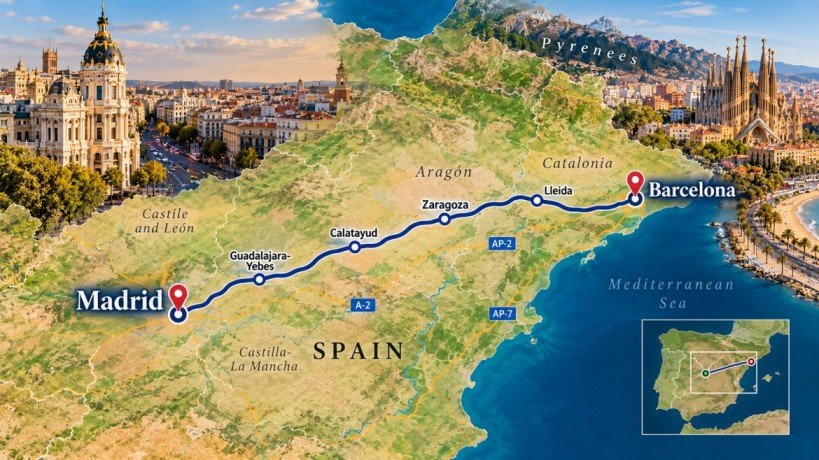
Is There a Direct Train From Madrid to Barcelona?
Yes. The route is one of Europe’s busiest high-speed corridors, and all trains run on the same track. Three operators compete on it:
- Renfe: Spain’s national railway. It runs the AVE, its full-service high-speed train, and Avlo, its low-cost brand. It has the most departures.
- iryo: a private operator with newer trains, several fare types and flexible tickets.
- Ouigo Spain: the low-cost option, with the lowest starting fares and stricter luggage limits.
Most services are direct. Some trains stop at cities such as Zaragoza and Tarragona, which adds time but not a change of train.
Madrid to Barcelona Train Duration: How Long Does It Take?
The fastest trains cover the roughly 500 km in about 2 hours 30 minutes. The average is closer to 3 hours, and slower services with more stops can take up to about 3 hours 15 minutes or a little longer. Before you book, compare the arrival time, not only the price, because the cheapest departure is sometimes the slowest one.
Madrid to Barcelona Train Cost and How to Buy Tickets
| Operator | Advance fares from | Notes |
|---|---|---|
| Ouigo | about €9 | Lowest fares, strict luggage rules |
| Renfe Avlo | about €7–9 | Low-cost brand, no catering |
| iryo | about €15 | Several fare types, flexible options |
| Renfe AVE | about €17–25 | Most departures, full-service |
Most people pay around €30 to €50 when they book ahead, and last-minute or peak-time tickets can climb well past €100. Fares change constantly, so check the operator’s site for your date.
Choosing an operator
If price is your priority, compare Ouigo and Avlo first, but check the luggage rules before you commit. If you want flexibility or a more comfortable ride, look at iryo or the AVE. The cheapest fare is not always the best deal once you add a larger bag.
How to book
Book directly on Renfe, iryo or Ouigo, or use a booking site that compares all three. Seat reservations are compulsory on every service, and your seat is assigned when you buy the ticket.
Train Times: First Train, Last Train and Frequency
Expect 30 or more trains a day, with a departure roughly every 30 to 40 minutes at peak times. The first trains leave early in the morning, around 6 a.m., and the last departures leave in the evening, around 9:30 p.m. Schedules shift by season and day of the week, so check live times before you plan your day.
Madrid to Barcelona Train Route Map
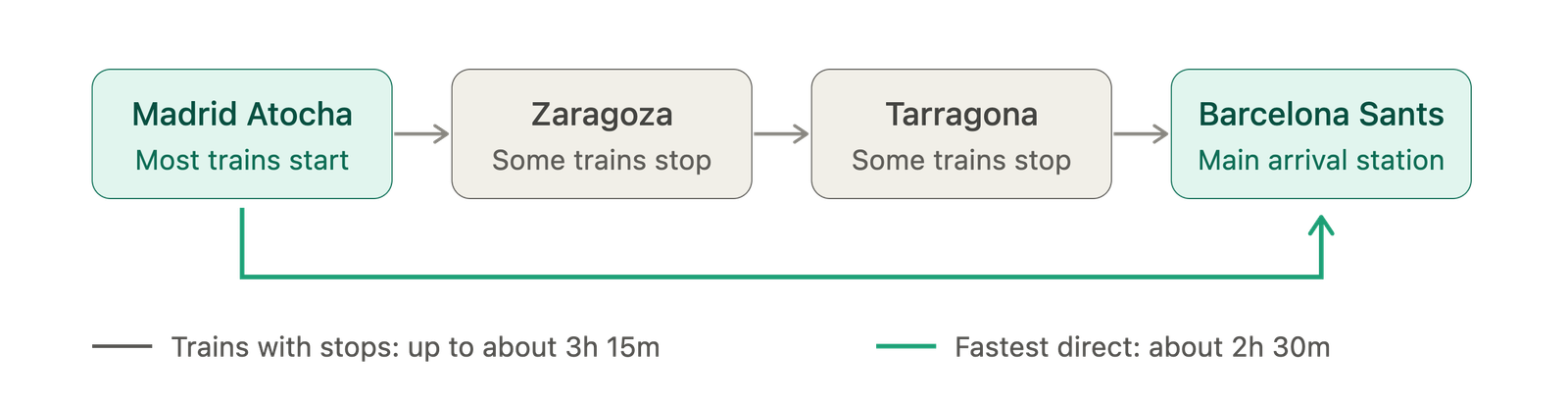
The route runs northeast across Spain on a dedicated high-speed line, about 500 km from Madrid to Barcelona. The fastest trains skip the intermediate stops, while some services call at Zaragoza and Tarragona on the way.
Stations: Madrid Atocha and Barcelona Sants
- Madrid Puerta de Atocha is the main departure point for most services, including the AVE, iryo and Ouigo. It’s central, close to the Retiro Park and the museum district, and connected to the metro and commuter trains. Some Renfe services leave from Chamartín–Clara Campoamor in the north of the city, so check which station is on your ticket.
- Barcelona Sants is the main arrival station for all three operators. It’s connected to the metro and local trains and sits close to the city centre.
Both stations have airport-style security checks before you board, so allow time. Arrive at least 20 to 30 minutes before departure, and a bit earlier at busy times.
Luggage Rules on Madrid to Barcelona Trains
Luggage rules differ by operator and fare, so check before you book:
- Renfe (AVE): up to three pieces per passenger, each up to 85 x 55 x 35 cm, with a combined limit of 25 kg. Extra bags cost a little more.
- iryo: it depends on your fare. The cheapest fare limits you to a small bag and a cabin bag, and a larger bag costs extra. Higher fares include a larger suitcase.
- Ouigo: a small bag and a cabin bag are included. Extra luggage can be added for a small fee when you book, and it’s cheaper to add it then than later.
Oversized bags can mean a fine at boarding, so measure your suitcase. If you’re travelling with a large suitcase, an AVE or a higher iryo fare is usually the safer choice.
Practical Tips for the Journey
- Compare all three operators for your date, because the cheapest one changes by time of day.
- Book early for the lowest fares, especially for weekends, holidays and Friday or Sunday evening trains.
- Check the fine print on the fare type, including luggage, changes and refunds.
- Arrive early to clear security without rushing.
- Keep your seat number handy. Seat reservation is compulsory on every service.
- Bring snacks or water. Catering varies by operator, and some low-cost trains have none.
Other Ways to Get From Madrid to Barcelona
The train is the best choice for most travellers. Here is how the alternatives compare.
By plane
Flights take about an hour and a quarter in the air, but check-in, security and airport transfers push the real door-to-door time to about the same as the train, or longer. Fares vary widely. The train usually wins on convenience, since you arrive in the city centre and skip airport queues.
By bus
Alsa and FlixBus run buses on this route, taking about 7.5 to 8.5 hours. Fares are usually in the €20 to €55 range. Buses are a backup option, but with advance train fares starting so low, the train is often cheaper and far faster.
By car
The drive is about 620 km each way and takes around 6 hours without long stops, plus fuel and tolls. A car makes sense if you want to stop along the way, such as in Zaragoza, or if you’re travelling as a group with a lot of luggage. Remember to factor in parking in Barcelona.
Frequently Asked Questions
Is there a direct train from Madrid to Barcelona?
Yes. Renfe, iryo and Ouigo all run direct high-speed trains between the two cities.
How long does the Madrid to Barcelona train take?
The fastest trains take about 2 hours 30 minutes. Most take around 3 hours, and slower services with stops can take up to about 3 hours 15 minutes.
How much is a Madrid to Barcelona train ticket?
Advance fares start from about €9 on Ouigo and around €7 to €9 on Avlo. iryo starts from about €15 and the AVE from about €17 to €25. Many travellers pay €30 to €50, and last-minute fares can be much higher.
Which station does the train leave from in Madrid?
Most trains leave from Madrid Puerta de Atocha. Some Renfe services use Chamartín–Clara Campoamor, so check your ticket.
Which station does the train arrive at in Barcelona?
Barcelona Sants.
Do I need to reserve a seat?
Yes. Seat reservation is compulsory on every service, and your seat is assigned when you buy your ticket.
How much luggage can I take?
It depends on the operator and fare. Renfe allows up to three pieces, iryo depends on your fare, and Ouigo includes a small bag and a cabin bag, with extra luggage available for a fee. Check the rules before you book.
Which operator is best?
Ouigo and Avlo are usually cheapest, iryo is more flexible, and Renfe’s AVE has the most departures. The best choice depends on your date, price and luggage.
Prices and schedules may change. Confirm current details on the operator’s website before booking.