The Barcelona to Madrid train is the easiest way to cross Spain’s busiest high-speed corridor, and you have three operators to pick from. Renfe’s AVE, Ouigo and Iryo all run direct services from Barcelona Sants to central Madrid, with dozens of departures a day. Normally the trip takes about two and a half hours, but there’s a temporary slowdown right now, which this guide explains. It also covers fares, stations, luggage rules and how the train compares with flying, the bus and driving.
Heads-up for 2026: Speed restrictions on part of the line have added roughly 25 minutes to every service. Budget closer to three hours until the restrictions are lifted, currently expected around mid-December 2026.
Is There a Direct Train From Barcelona to Madrid?
Yes. Three companies run direct high-speed trains on the same tracks:
- Renfe (AVE and the low-cost Avlo): Spain’s national operator, with the most departures.
- Iryo: a private operator that started in 2022, known for newer trains and more comfort.
- Ouigo: SNCF’s low-cost brand, with the cheapest fares and fewer departures.
All of them leave from Barcelona Sants and arrive in central Madrid, usually at Atocha and sometimes at Chamartín.
Barcelona to Madrid Train Duration: What to Expect
In normal conditions, the fastest trains take about 2 hours 30 minutes to 2 hours 40 minutes, with the average closer to 2 hours 40. Since the speed limits came into force in early 2026, expect about 3 hours to 3 hours 15 minutes on most services. All three operators are affected, so the choice of operator won’t change your journey time much.
Check the exact arrival time when you book. A few services take longer, and booking sites show the real duration for your date.
Barcelona to Madrid Train Cost: AVE vs Iryo vs Ouigo
| Operator | Cheapest advance fares | Typical fares closer to travel |
|---|---|---|
| Ouigo | From about €9 | €20–35 |
| Iryo | From about €15 | €30–50+ |
| Renfe AVE | From about €17 | €40–70+ |
Last-minute tickets can climb to around €130. As a sample, a recent midweek morning departure booked about three weeks ahead came out at roughly €19 on Ouigo, €47 on Iryo and €68 on AVE Turista. Prices change by date and demand, so check the live fare before you decide.
Which operator should you choose?
- Choose AVE if you want the most departure times, easier changes and a wide choice of fare classes. It has 20+ daily trains.
- Choose Iryo if you want a more comfortable ride with better onboard service, at a mid-range price. It runs roughly 10 to 16 trains a day.
- Choose Ouigo if price is your priority and you can plan ahead. It runs around five trains a day, and extras such as bigger bags and seat selection cost more, so the final price can rise.
Luggage and extras
Allowances differ by operator, and the rules change, so check before you buy. In general, Renfe allows one bag plus a suitcase, Iryo is the most generous with up to three pieces including two suitcases, and Ouigo allows one cabin bag plus a small item, with suitcases at an extra charge. All three offer Wi-Fi and onboard toilets, and power outlets are available at most seats on Renfe and Iryo, though more limited on Ouigo.
Train Times: First Train, Last Train and Frequency
Timetables shift by season and day, so treat this as the usual pattern:
- First train: from around 5:40 am with Renfe, and around 6:45 am with Ouigo.
- Last train: in the evening, typically around 9 pm.
- Frequency: dozens of direct trains a day across the three operators, though a few early and late services have been withdrawn during the current slowdown.
Book as early as you can for the best fares, especially for Friday and Sunday trips. Always check the live timetable on the operator’s own site.
Barcelona to Madrid Train Route Map
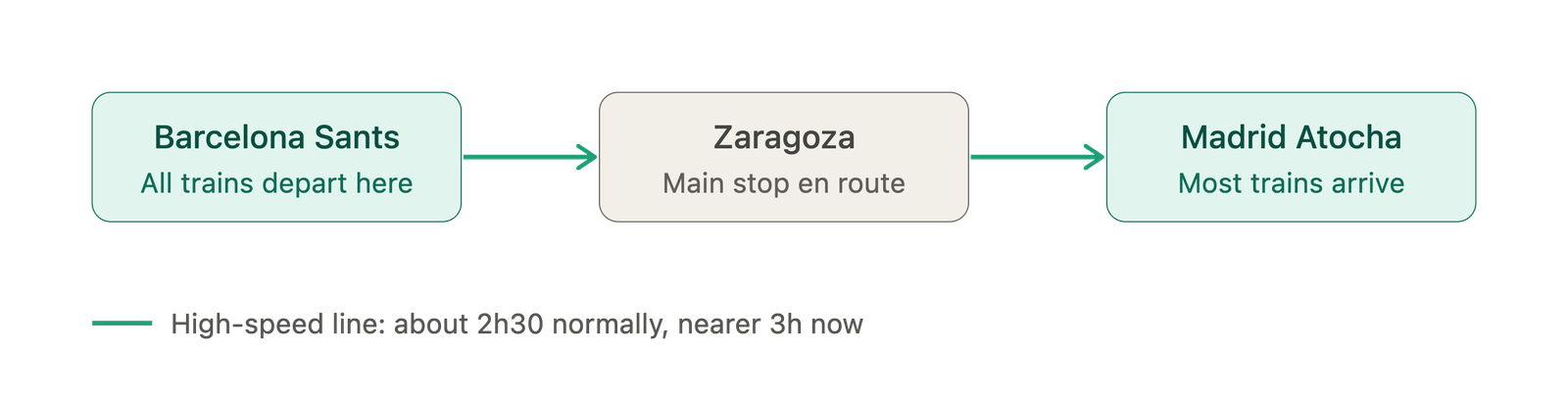
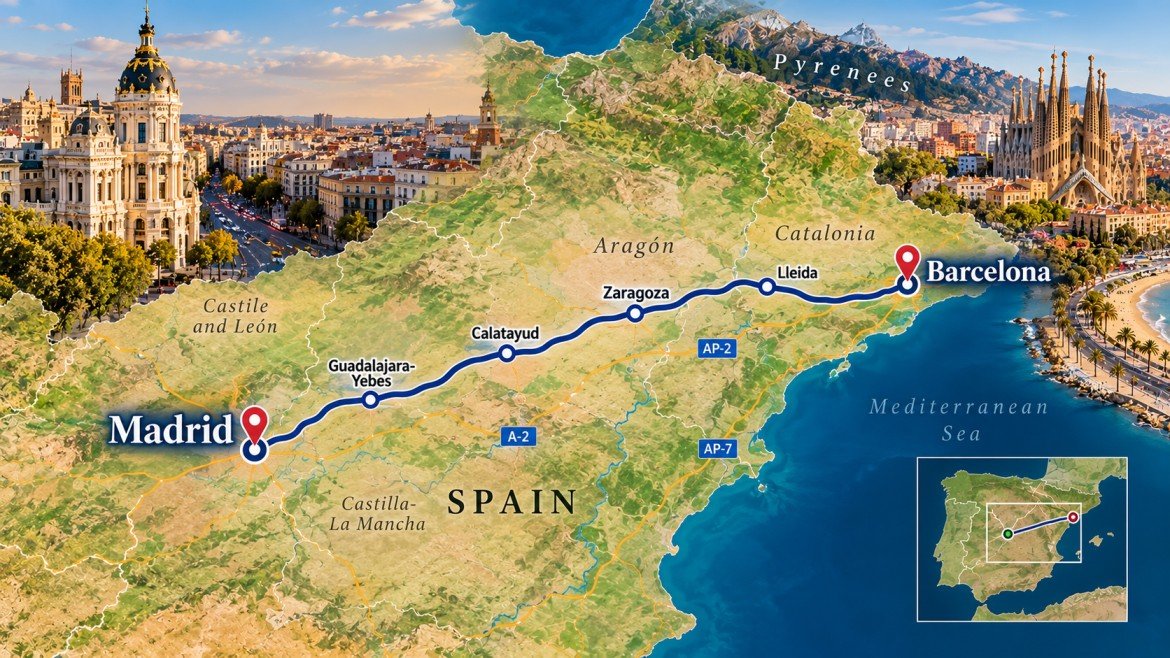
The line runs about 620 km across Catalonia and Aragon before reaching the Madrid region. Zaragoza is the main stop on the way, and some services also call at Camp de Tarragona, Lleida and other stations.
By plane
The flight itself takes about 1 hour 15 minutes, but airport transfers, security and baggage bring the door-to-door time to roughly 3.5 hours. Fares range widely, about €50 to €170. With the train now taking around 3 hours centre to centre, flying rarely saves time unless you’re connecting to another flight.
By bus
ALSA runs buses from Barcelona’s Nord station to Madrid every few hours. The journey takes about 7.5 to 8 hours, and fares run roughly €40 to €100. It’s the slowest option and often costs more than an early-booked Ouigo ticket, so it only makes sense if trains are sold out.
By car
The drive is about 620 km and takes around 6 hours without stops, plus fuel and tolls. A car makes sense if you’re visiting places along the way, such as Zaragoza, or travelling with a group and lots of luggage. For a simple city-to-city trip, the train is quicker and less tiring.
Frequently Asked Questions
Is there a direct train from Barcelona to Madrid?
Yes. Renfe AVE, Iryo and Ouigo all run direct high-speed trains from Barcelona Sants to Madrid, with no change needed.
How long does the Barcelona to Madrid train take?
Normally about 2 hours 30 minutes to 2 hours 40 minutes. Because of the current speed restrictions, expect about 3 hours to 3 hours 15 minutes until they are lifted.
How much is a train ticket from Barcelona to Madrid?
Advance fares start around €9 on Ouigo, €15 on Iryo and €17 on Renfe AVE. Closer to departure, expect €30–70+, and up to about €130 for last-minute seats.
Which is the cheapest train operator?
Ouigo usually has the lowest headline fares, but extras like larger bags and seat selection can raise the total. Compare the final price across all three.
Which station do trains arrive at in Madrid?
Most arrive at Madrid Atocha, close to the city centre, while some use Chamartín. Check your ticket.
How early should I arrive at Barcelona Sants?
Aim for 20 to 30 minutes before departure, to allow for security checks and finding your platform.
What are the first and last trains?
The first trains leave from around 5:40 am (Renfe) or 6:45 am (Ouigo), and the last are typically in the evening around 9 pm. Check the live timetable for your date.
Is the train better than flying?
For most travellers, yes. It runs centre to centre with no airport transfers, security queues or baggage fees, and the journey time is similar once you add airport time to the flight.
Prices, schedules and journey times may change. Confirm current details with Renfe, Iryo or Ouigo before booking.