Taking the Braga to Porto train is one of the simplest journeys you can make in northern Portugal. Comboios de Portugal (CP), the national railway, runs two very different kinds of service on this route — a cheap, frequent urban train and a faster long-distance option — so the right choice depends on whether you’re chasing speed or savings. This guide covers duration, cost, timetables, which Porto station to use, and how the train compares to the bus or a car.
Is There a Direct Train from Braga to Porto?
Yes. CP runs both direct urban trains and direct long-distance trains between Braga and Porto, so there’s no need to change trains either way. The urban service runs roughly every 30 to 60 minutes for most of the day, while a smaller number of faster Intercidades and Alfa Pendular trains cover the same route with fewer stops. Between the two services, there are well over 20 departures a day, making this one of the easier city-to-city hops in Portugal to plan around.
Braga to Porto Train Duration: Urban vs Intercidades/Alfa Pendular
Urban Train Duration
The Comboios Urbanos do Porto service (part of the Linha do Minho) is a stopping train that calls at numerous small stations along the way. It typically takes 55 to 75 minutes, depending on how many stops that particular service makes. It’s slower than the express option, but it runs far more often and doesn’t require booking ahead.
Intercidades and Alfa Pendular Duration
The Intercidades (IC) and Alfa Pendular (AP) trains cut out most of the intermediate stops and cover the same distance in around 38 to 45 minutes. The Alfa Pendular is Portugal’s tilting high-speed train, reaching up to 220 km/h, and both services offer air conditioning, onboard Wi-Fi, and (on the AP) a bar/café car. These trains run far less frequently — typically around 6 to 8 times a day — since they’re really long-distance services passing through on their way between Braga, Porto, Lisbon, and beyond.
Braga to Porto Train Cost
Ticket prices depend heavily on which service you choose:
- Urban train: around €3.50–4 one-way (single Zone 8 fare on the Porto urban network)
- Intercidades: roughly €14–19 in 2nd class, more in 1st class
- Alfa Pendular: roughly €18–27 depending on class (Turística vs Conforto)
Discounts apply nationwide on CP services: children under 4 travel free, kids aged 4–12 get 50% off, travellers under 25 get 25% off, and passengers 65 and older get 50% off. On the urban network, fares are prepaid onto a rechargeable smart card rather than a paper ticket.
How to Buy Braga to Porto Train Tickets
For the urban train, tickets are loaded onto a reusable Siga card (a small one-time card fee applies), bought at ticket machines or counters at Braga, São Bento, or Campanhã station — there’s no need to book ahead, and seats aren’t reserved. For Intercidades and Alfa Pendular, book through cp.pt or an authorised reseller like Omio, since seat reservation is compulsory on these long-distance services and popular departures can sell out.
Braga to Porto Train Schedule and Timetable
Timetables shift slightly by season and day of the week, so treat the following as a general pattern rather than fixed departure times:
- First train: urban services typically start around 6:00–6:45 AM
- Last train: the final departure from Braga runs into the evening, generally around 11:00–11:30 PM
- Frequency: urban trains roughly every 30–60 minutes on weekdays, slightly less often on weekends; Intercidades/Alfa Pendular a handful of times per day
- Journey time: 55–75 minutes on the urban train, 38–45 minutes on Intercidades/Alfa Pendular
For live departure times, seat availability, and current fares, check cp.pt directly or compare options through Omio.
Braga to Porto Train Route Map
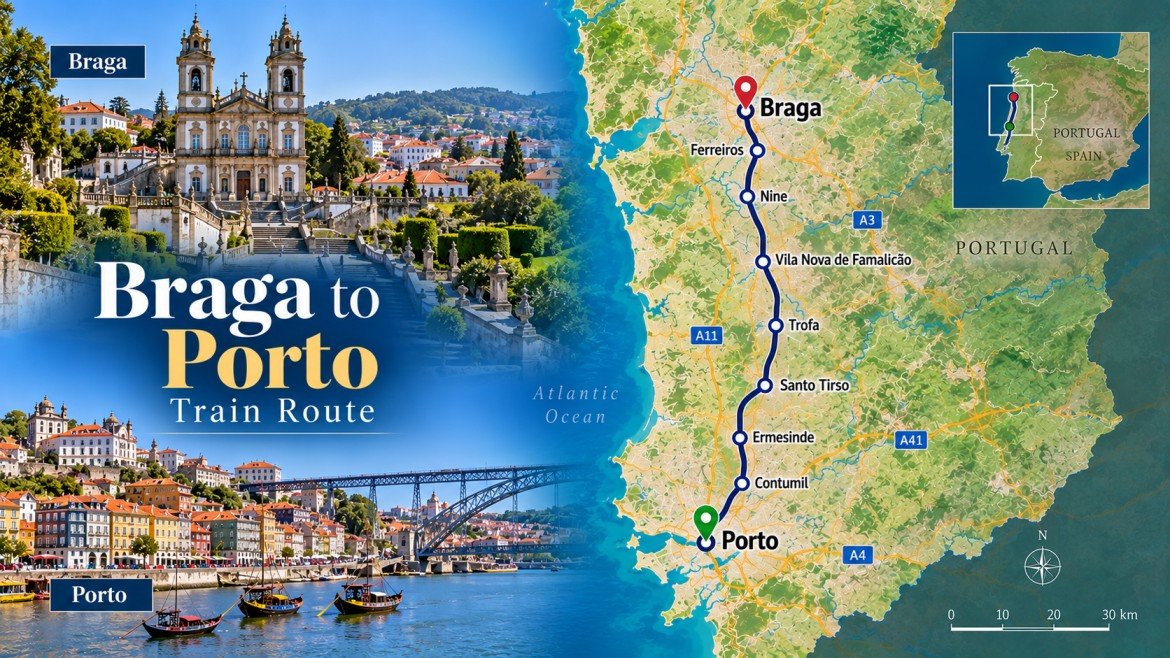
This route runs along the Linha do Minho, Portugal’s rail line connecting Porto to the Spanish border at Valença. Braga sits near the southern end of that line, so most Braga to Porto train services are really continuing further north or south — which is part of why departures are so frequent. The distance is about 47 km by rail (roughly 55 km by road), and the urban route passes through smaller towns like Nine and Famalicão before reaching Porto.
Which Porto Station Should You Arrive At?
Both Braga and Porto have more than one relevant station, and it’s worth knowing the difference before you plan the rest of your day:
- Porto São Bento is the central terminus, a short walk from the Ribeira district and most tourist sights, and served by the metro’s D (yellow) line. It’s the more convenient arrival point for most visitors — but only urban trains stop here.
- Porto Campanhã is the larger interchange station, used by Intercidades and Alfa Pendular trains, as well as connections toward Lisbon and Spain. It’s a few minutes further from the historic centre by metro.
If you’re taking the faster long-distance train, you’ll arrive at Campanhã rather than São Bento, so factor in a short metro ride into the centre.
Station Guide: Braga and Porto Stations
In Braga, the train station is a terminus on the western side of the city, and it’s a pleasant 10–15 minute walk to the historic centre. In Porto, São Bento sits right in the middle of the action, while Campanhã is a larger through-station a bit further out, well connected to the metro network either way.
Practical Tips for Your Journey
- Seat reservations are not needed on the urban train, but they’re compulsory on Intercidades and Alfa Pendular — book those in advance if your dates are fixed.
- If travelling on the urban network, remember to validate your Siga card on the platform pedestal just before boarding; an unvalidated card counts as an invalid ticket.
- Check which Porto station your train uses before booking accommodation, since São Bento and Campanhã aren’t within easy walking distance of each other.
- Arrive 10–15 minutes early for the urban train, and a bit earlier for reserved long-distance services, especially in summer.
- Standard luggage allowance is one main bag plus a personal item; the urban trains don’t have dedicated luggage racks, so keep bags with you.
Other Ways to Travel from Braga to Porto
By Bus
FlixBus and Rede Expressos both run buses on this route, typically taking around 45 minutes to just over an hour. Fares are often cheaper than the urban train and comparable to Intercidades pricing, making the bus a reasonable backup if train times don’t line up.
By Car
Driving via the A3 motorway takes roughly 45 minutes to an hour, tolls included. It’s a sensible option if you’re continuing on to other towns in the Minho region afterward, though parking in central Porto adds time and cost.
By Taxi or Rideshare
Uber and Bolt cover this route too, usually costing significantly more than the train — often €40 or more depending on demand — but offering door-to-door convenience if you’re travelling with luggage or in a group.
FAQs
Are there direct trains from Braga to Porto?
Yes. Both the urban service and the Intercidades/Alfa Pendular trains run directly, with no changes required.
What is the Braga to Porto train duration?
The urban train takes about 55–75 minutes. Intercidades and Alfa Pendular cover it in roughly 38–45 minutes.
How much does a Braga to Porto train ticket cost?
The urban train costs around €3.50–4 one-way. Intercidades and Alfa Pendular fares run roughly €14–27 depending on class.
How frequent are trains from Braga to Porto?
The urban train runs roughly every 30–60 minutes on weekdays. Long-distance trains run only a handful of times a day.
Do I need to book a seat in advance?
Not for the urban train. Yes, it’s compulsory for Intercidades and Alfa Pendular.
Which Porto station do trains arrive at?
Either São Bento or Campanhã, depending on the service — check your ticket, since it affects where in the city you land.
Can I use a rail pass or the Siga card on both train types?
The Siga card only covers the urban network. Intercidades and Alfa Pendular require a separate ticket or reservation, even if you hold a rail pass.
Is the train faster than driving?
The fastest Alfa Pendular is comparable to or faster than driving once you factor in parking in Porto; the urban train is generally slower than a car.
Prices and schedules reflect CP fare data as of January 2026 and are subject to change. Always confirm current details on cp.pt before booking.